What the best customer conversations did differently in 2026

What separates a good customer conversation from a great one? The 2026 Auscontact Sales and Service Excellence Awards data suggests it isn’t simply getting to the answer.
The strongest conversations made the customer’s path easier. In Service, that meant setting expectations, keeping customers informed and explaining what came next. In Sales, it meant understanding why the customer was there, narrowing the options and making the recommendation relevant.
Those differences came down to small, observable behaviours. Exactly the kind of micro-behaviours that can be practised, coached and repeated.
Want to explore the full findings?
The 2026 Sales & Service Excellence Insights report brings together the standout results, finalist comparisons and real conversation examples from this year’s assessments.
Download the full Insights Report →
Service: solving the problem is only the beginning
Here’s an interesting place to start.
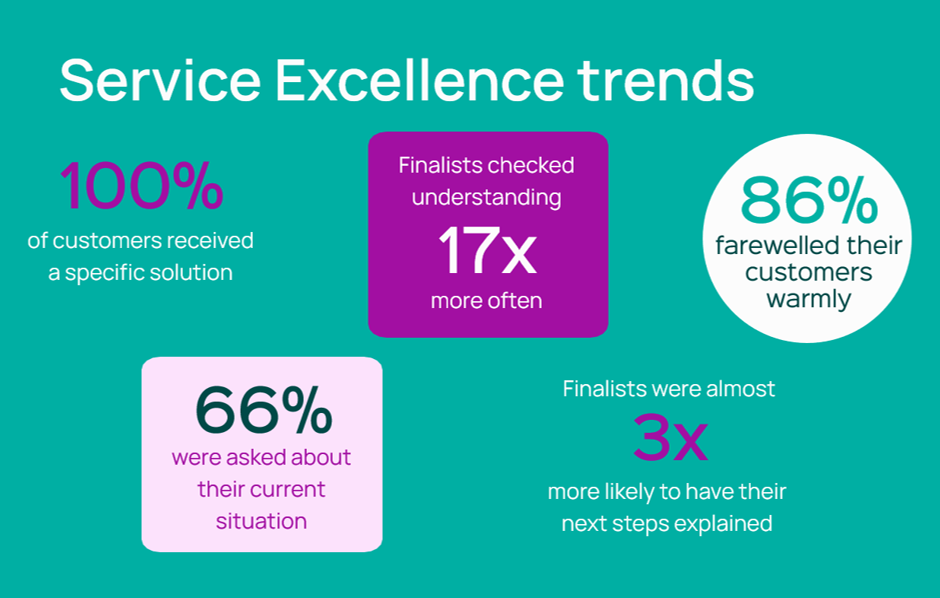
Every customer assessed in the 2026 Service Excellence Awards received a specific solution.
On the surface, that sounds like there shouldn’t be much separating the strongest organisations.
But there was.
The difference became clearer when we looked at what happened around the solution.
Service finalists were almost three times more likely to have their next steps explained, and checked understanding 17x more often.
The answer itself wasn’t the differentiator. How customers were guided towards, through and beyond that answer was.
And there are some well-established psychological principles that help explain why these small conversational behaviours can matter.
Make the conversation easier to navigate
Customers contact service teams with something they already need to think about. Making them also work out why they’re being asked certain questions, what the consultant is doing or what happens next adds unnecessary mental effort.
Giving customers a simple roadmap can reduce that load.
It might sound like:
“I’ll bring up your details, complete a quick security check and then take you through the options.”
Explaining the process gives the customer predictability. Keeping them informed reduces the need to interpret what's happening. Explaining next steps helps replace uncertainty about what comes after the conversation with a clearer expectation of what to expect.
In simple terms: the less customers have to work out for themselves, the easier the experience can be.
Give direction without taking away control
There’s another small behaviour in the results that matters: seeking permission.
Adding:
“Does that sound okay?”
or:
“Are you happy for me to go through that with you?”
does more than make the conversation polite.
Psychological research around autonomy and perceived control gives us a reason to value these moments. People generally respond differently when they feel involved in a process rather than simply having it happen to them.
So there is a useful balance:
Give customers enough direction that the experience is easy to navigate, while giving them enough agency that they remain part of the conversation.
Don’t assume an explanation has landed
The same principle applies to checking understanding.
A consultant can explain something clearly from the consultant's perspective without knowing whether the customer has understood it in the same way.
Questions such as:
“Does everything make sense for you?”
or:
“Is there anything you'd like me to clarify?”
create a deliberate pause between hearing information and acting on it.
The customer gets an opportunity to process the explanation, identify anything that remains unclear and ask questions before the conversation moves on.
That’s why the behaviour is more meaningful than simply “checking a box”. It creates space for comprehension.
And don’t underestimate the goodbye
One of the stronger behaviours across the 2026 Service cohort was the personalised, engaging farewell, observed in 86% of assessed conversations.
There’s a useful psychological lens here too.
Research into the recency effect tells us that the end of an experience can be particularly memorable. That doesn't mean a warm goodbye automatically creates a positive customer experience, but it does give us good reason to pay attention to how customer conversations finish.
A personalised farewell is the final opportunity to acknowledge the customer, reinforce any next step and finish the interaction as a human conversation rather than simply ending once the transaction is complete.
It’s a small behaviour, but an important moment.
The beginning sets expectations. The middle delivers the experience. The ending helps shape what the customer takes away from it.
Give customers a map
This was particularly evident in nib Group Travel’s conversations.
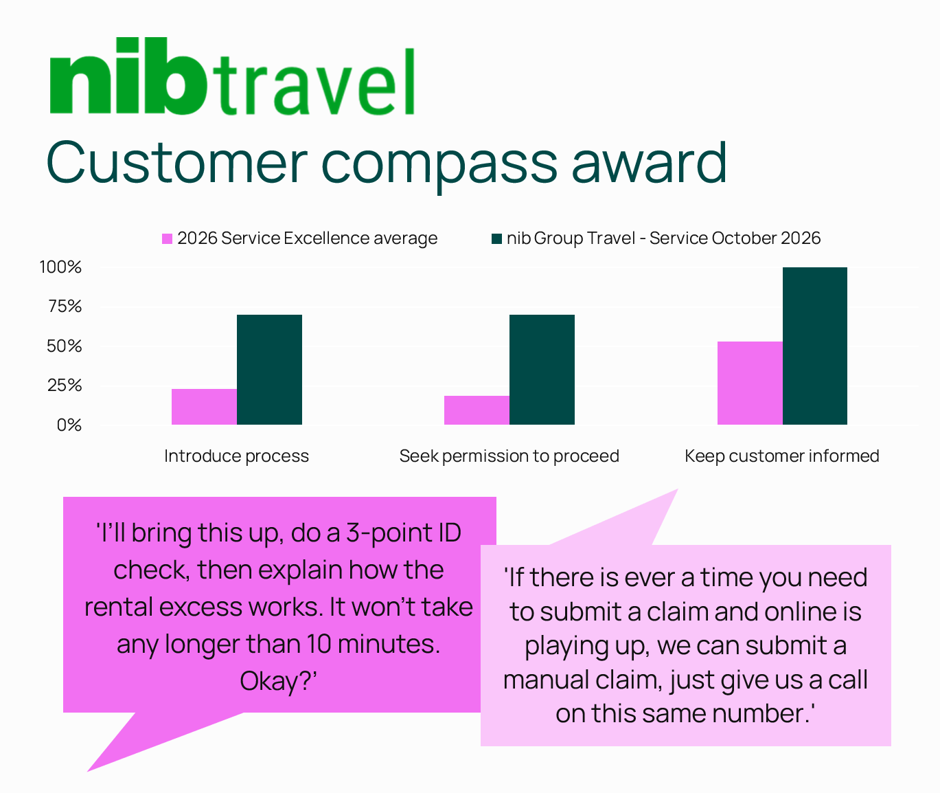
The 2026 Service Excellence winner introduced the process in 70% of assessed conversations, compared with 23% across the overall Service Excellence cohort. nib Group Travel also sought permission to proceed in 70% of its assessed conversations and kept customers informed in every applicable conversation.
The value is in how those behaviours work together.
Customers receive sign posts throughout the conversation:
Here’s what we’re doing → here’s what will happen → is that okay? → here’s where we are now → here’s what happens next.
That’s why nib Group Travel received the Customer Compass award.
For leaders listening to customer conversations, the coaching opportunity is practical:
At the beginning of the conversation, briefly explain what you’re going to do and ask whether that works for the customer.
It provides context for everything that follows.
Don’t assume understanding
There was another Service behaviour that deserves attention.
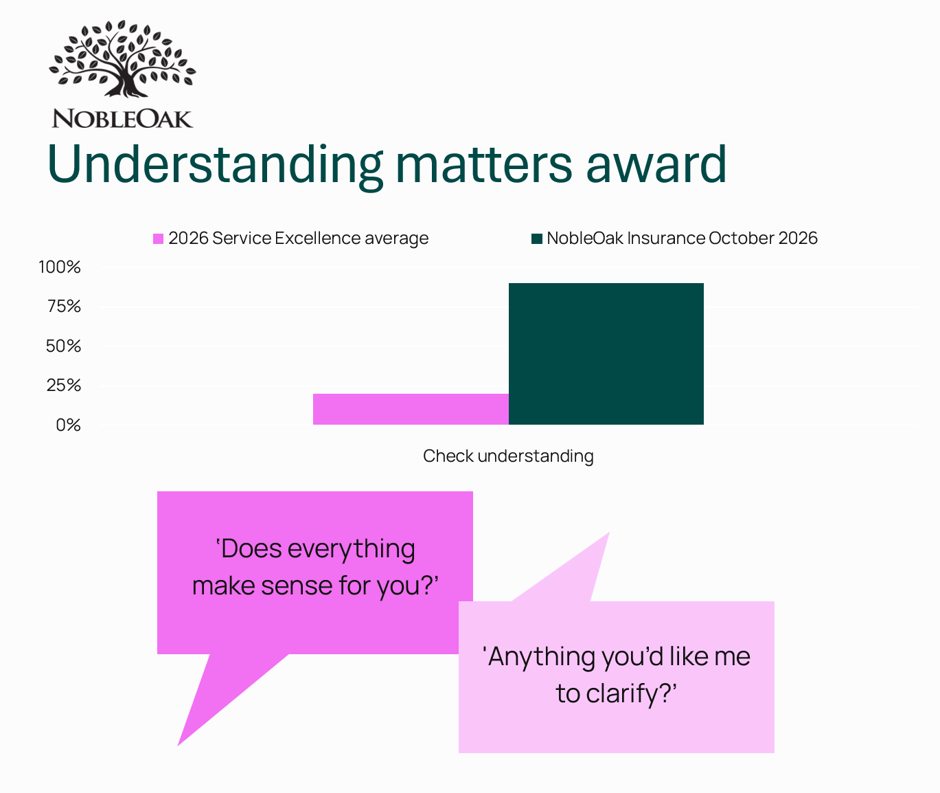
NobleOak Insurance checked customer understanding in 90% of its assessed Service conversations, compared with a 20% Service Excellence average.
That sounds simple.
It is.
But simple doesn’t mean unimportant.
Consider the difference between finishing an explanation and immediately moving on, versus pausing to ask:
“Does everything make sense for you?”
or:
“Anything you’d like me to clarify?”
One delivers information. The other creates space for the customer to participate.
NobleOak Insurance received the Understanding Matters award for making understanding an active part of the conversation.
There’s a useful distinction for leaders reviewing conversations.
Instead of only asking:
“Did the consultant explain it?”
also ask:
“How did the consultant know the customer understood?”
Those are not quite the same thing.
Make personalisation specific
Australian Red Cross Lifeblood showed another side of strong service.
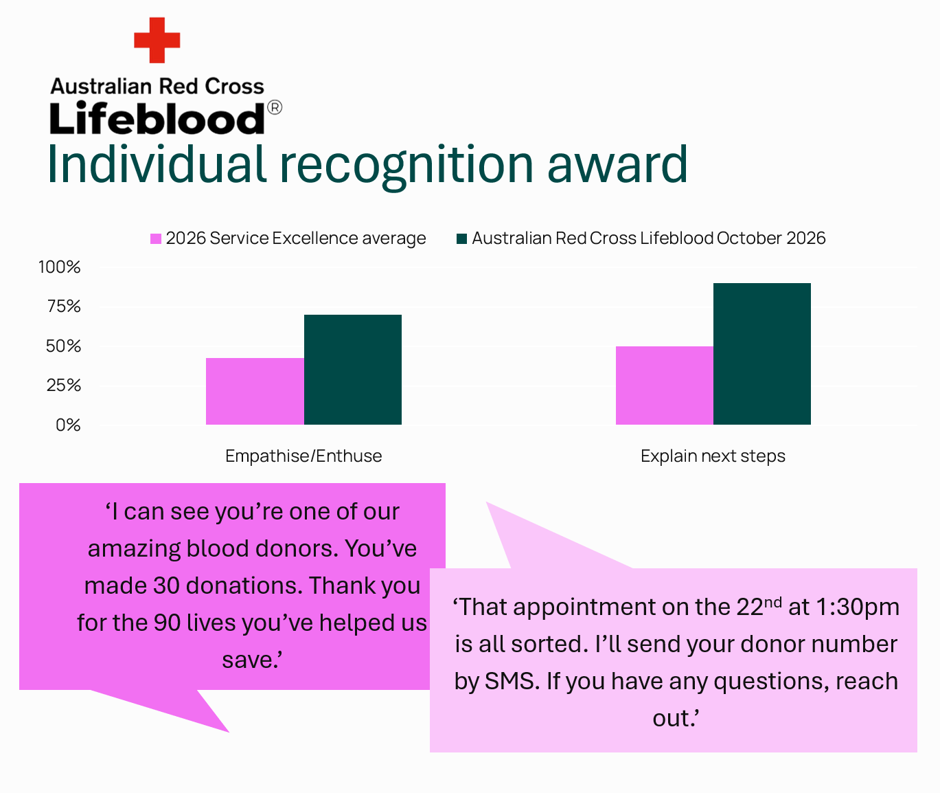
Its assessed conversations combined individual recognition with practical guidance about what happened next. The report records 70% for empathise/enthuse and 90% for explaining next steps for Australian Red Cross Lifeblood.
The interesting part is the specificity.
One conversation included:
“I can see you’re one of our amazing blood donors. You’ve made 30 donations. Thank you for the 90 lives you’ve helped us save.”
That isn't generic warmth. It responds to something specific about the individual.
It’s why Australian Red Cross Lifeblood received the Individual Recognition award.
A useful question when reviewing a conversation is:
Could this exact interaction have happened with any customer, or did something change because of what this customer told us?
That’s a more meaningful test of personalisation than simply counting how often someone uses the customer’s name.
Sales: good discovery creates focus
Customers may start with a practical request:“I’m looking for life insurance.”
But decisions are rarely made on practical information alone. Research into decision-making, including the Somatic Marker Hypothesis, supports the role emotion and feeling can play in helping people evaluate options and make decisions, particularly when choices involve uncertainty.
That gives us another reason to look beyond what the customer wants and understand why it matters to them.
Someone looking for life insurance may ultimately be thinking about protecting a new baby, keeping the mortgage covered or making sure their family has financial security.
That changes the conversation.
The WHAT tells you what they’re looking for. The WHY helps you understand why it matters.
Once that motivation is understood, the consultant has better context to make the recommendation personally relevant.
Use discovery to create focus
Good discovery should also help narrow the decision.
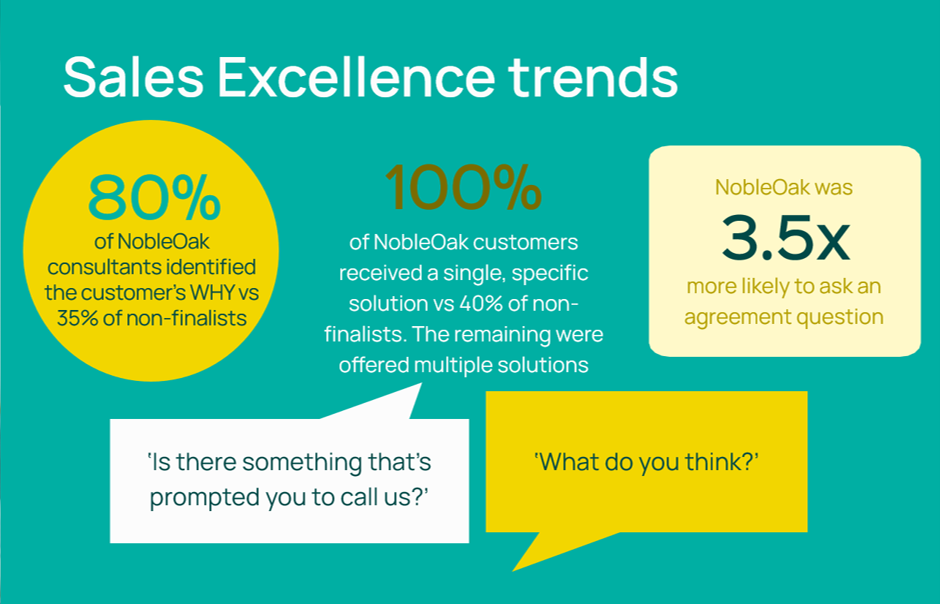
In the 2026 assessments, NobleOak Insurance provided a single, specific solution in 100% of conversations, compared with 40% for non-finalists.
Research into choice overload and decision complexity gives us a useful lens here. More choice isn't automatically worse, and the effect depends on the context, but too many competing options can make decisions more demanding.
That's where needs analysis earns its place.
If the consultant understands what matters, the customer doesn't necessarily need to sort through every possible option. The consultant can do some of that filtering and arrive at a more focused recommendation.
The value of good discovery isn't more options. It's having enough information to narrow them.
Build agreement before asking for commitment
There's one more small behaviour worth noticing.
NobleOak Insurance was 3.5 times more likely to ask an agreement question than non-finalists.
Something as simple as:
“Does that sound like it meets your expectations?”
creates a useful decision point before asking for the sale.
There is a recognised psychological principle behind the idea that a small, voluntary agreement can make a subsequent related agreement somewhat more likely. It's commonly known as the foot-in-the-door effect, and research suggests the effect is real but modest and dependent on context.
But perhaps more importantly in a customer conversation, an agreement question tells you whether the recommendation has actually landed.
If the customer says yes, progressing towards commitment becomes a natural next step.
If they don't, you've uncovered something that needs to be explored before asking for the sale.
So rather than thinking about agreement questions simply as a technique for getting a customer to say yes, think of them as:
Understand → recommend → check alignment → invite commitment.
That creates a more natural progression towards the sale, while keeping the customer actively involved in the decision.
Make the product relevant
There’s another distinction in the Sales data that is particularly useful for coaching.
Features were explained in every assessed sales conversation, so product knowledge wasn’t the main differentiator.
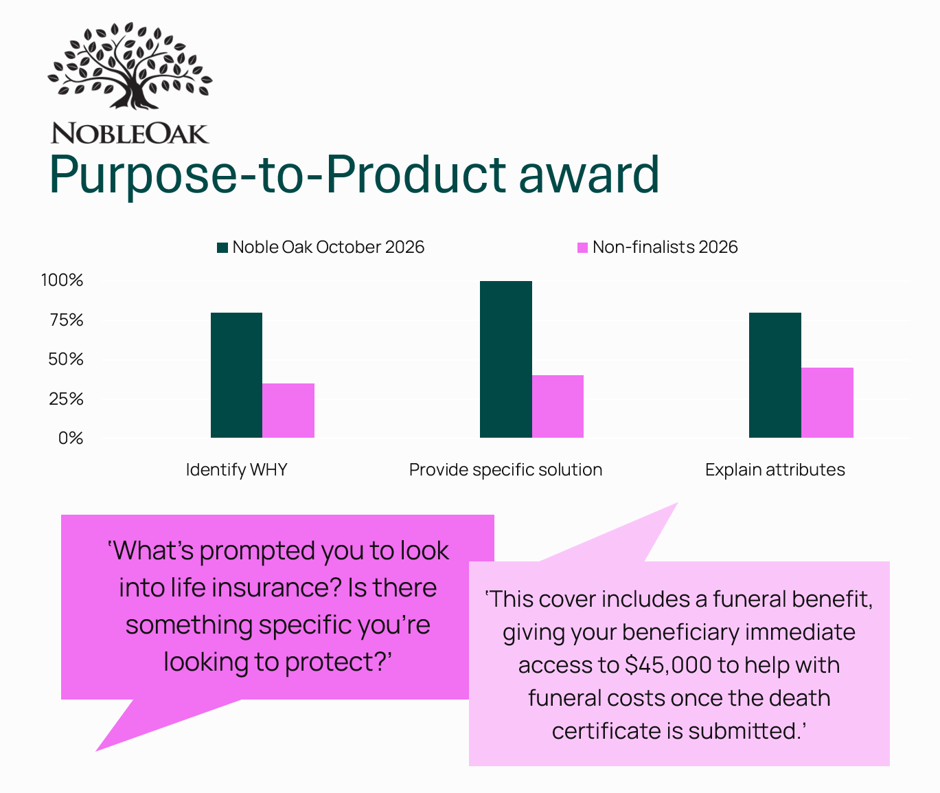
NobleOak Insurance explained benefits and attributes in 80% of its assessed conversations, compared with 45% for non-finalists.
The difference becomes clearer when you hear what that sounds like.
A feature tells the customer what is included.
The next step is explaining what that means in practical terms.
For example:
“This cover includes a funeral benefit, giving your beneficiary immediate access to $45,000 to help with funeral costs once the death certificate is submitted.”
That explanation moves beyond naming the feature to describing its practical benefit.
That’s the behaviour worth coaching.
Not:
“Explain more features.”
Instead:
After explaining an important feature, connect it to what it means for this customer.
This ability to connect customer purpose to a relevant product recommendation is why NobleOak Insurance received the Purpose-to-Product award.
What changed from 2025?
Looking at the two years side by side gives useful context.
For Service, providing a specific solution remained at 100% in both 2025 and 2026. Some behaviours increased, including process introduction, seeking engagement, explaining next steps and checking understanding. Others decreased, including customer-name use, education related to the main enquiry and personalised farewells.
In Sales, several behaviours were observed more frequently in 2026 than 2025, including strong statements of assistance, customer-name use, seeking engagement, identifying WHY, product features and confident sales closing. Other behaviours, including open feature questions and personalised farewells, were observed less frequently.
What caught our attention, though, wasn't simply whether individual behaviours moved up or down.
It was how the strongest behaviours connected.
A question informed a recommendation.
A feature was translated into a benefit.
A solution was followed by a next step.
An explanation was followed by an understanding check.
Viewed together, the findings reinforce a useful point:conversation quality isn’t simply a checklist of behaviours. It’s also about how those behaviours work together and when they appear in the customer journey.
Turning insight into something teams can practise
An analysis like this could easily end with a long list of things consultants should improve.
We’d suggest doing the opposite.
Pick one moment. Pick one behaviour. Get specific.
For a Service team, that could be:
Before moving on from the solution, explain what will happen next.
For a Sales team:
Before recommending a product, articulate what you heard matters most to the customer.
Or, if product knowledge is strong but benefit explanation is inconsistent:
Choose one important feature and explain what it means for this customer.
These are easier to observe and coach than goals like “improve customer experience”, “build better rapport” or “improve discovery”.
Then listen again.
Did the behaviour happen?
Did it happen at the right moment?
Did it sound natural?
Did it help create the intended experience?
That’s where performance data becomes useful: not simply when it tells you what happened, but when it gives people something practical to work on.
Explore the full 2026 insights
These are just some of the patterns from the 2026 Auscontact Sales and Service Excellence Awards.
The full 2026 Sales & Service Excellence Insights Report explores the results in more detail, including comparisons, stand out micro-behaviours and practical examples from assessed conversations.
Download the 2026 Sales & Service Excellence Insights Report →
Ready to Start Your Pathway?
Ready to move from ideas to results? Pick a quick demo to see workflows, or a discovery call to discuss your challenges. We’ll tailor the pathway.