Lesson learned: The Behavioural Path
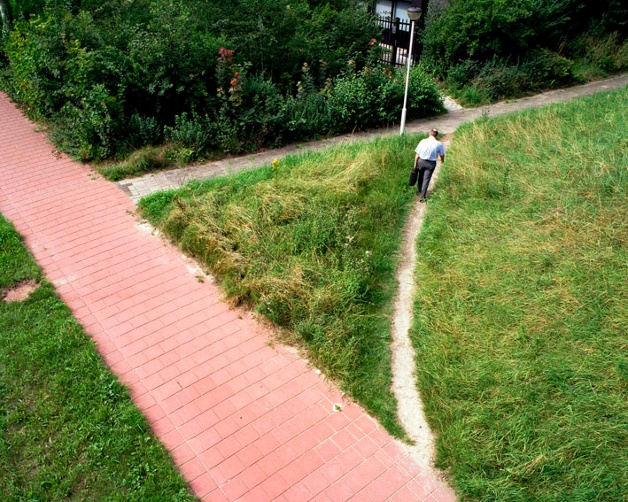
YakTrak Managing Director, Peter Grist reflects on a simple observation that has shaped much of his thinking over the years. Inspired by a dirt track worn through the grass beside a carefully designed pathway, he explores the gap between intention and reality, and why people's behaviours often reveal more than their words ever can. It's a thoughtful reflection on human nature, organisational behaviour and the lessons hiding in plain sight.
A few weeks ago, I came across a LinkedIn post from Alistair Glass that caught my attention.
The photo in the post showed a neatly paved path crossing a patch of grass, complete with lighting and a bench. It looked well designed, thoughtfully planned and professionally built.
What had caught Alistair’s attention wasn't the path itself.
It was the dirt track worn diagonally through the grass beside it.
Nobody had designed that path. Nobody had approved it or included it in a project plan. It existed because hundreds of people had independently decided there was a better way to get from one place to another.
The more I looked at the photo, the more I realised I'd spent much of my career seeing versions of the same thing.
Not in parks.
In organisations.
Over the years I've sat through countless interviews, workshops, focus groups and stakeholder discussions. Much of my career has been spent helping organisations understand the behaviours that drive customer experience, leadership effectiveness and performance improvement.
Looking back, I've realised those dirt paths appear everywhere. People rarely follow the path exactly as it was designed. Instead, they create their own, shaped by priorities, pressures, habits and incentives. If you pay attention, those paths can tell you a great deal about what really matters.
I've always known that observing behaviour is one of the most reliable ways to understand what people value. The challenge has been that doing it well is difficult, expensive and often limited to small samples. As a result, we tend to fall back on the easier option of asking people what they want and what they need.
To a point, that works.
The challenge is that people are not always great predictors of their own behaviour. They are usually honest. They genuinely tell us what they believe is important. But when competing priorities, limited time and human habits come into play, what people actually do often tells a slightly different story.
A leader may tell you that coaching is a top priority while spending most of their week resolving issues and attending operational meetings. A customer may say they want more options while consistently choosing the simplest path available. A team may ask for a new process while simultaneously creating a series of workarounds that avoid large parts of the current one.
The behaviour isn't wrong. In fact, it's usually completely rational. It reveals the trade-offs people are making and, in doing so, provides an unfiltered view of what they truly value.
We've certainly learned this lesson ourselves.
Over the years we've built solutions based on things customers, leaders and organisations told us they wanted. We've developed better reporting and dashboards to provide greater visibility. We've introduced more configurable forms and workflows to create flexibility. We've built leadership tools, resources and self-directed learning content to make development easier and more accessible.
None of these were bad ideas, and many delivered genuine value. In most cases the feedback was positive. Stakeholders would agree the solution made sense and solved a real problem.
Yet adoption didn't always follow in the way we expected.
Some initiatives gained momentum immediately. Others required far more effort, encouragement and reinforcement than seemed reasonable for something people had specifically asked for.
For a long time, I assumed that meant we hadn't communicated well enough, trained people effectively enough or launched the solution properly. Looking back, that was probably a more comfortable explanation because it allowed me to believe the solution itself was right and the challenge was simply getting people to adopt it.
Sometimes those things were part of the answer.
More often, however, we were relying too heavily on what people said and not paying enough attention to what they did.
The clues were usually there if we looked closely enough.
Where were people spending their time?
What activities were they avoiding?
What shortcuts had emerged?
What workarounds had become common practice?
What administrative effort were people constantly trying to eliminate?
The answers to those questions were often far more revealing than the responses we received in interviews or surveys.

What makes this lesson particularly interesting today is that we're becoming far better at observing the paths people actually take.
Historically, observing behaviour at scale has been difficult. We've relied on interviews, workshops, surveys, focus groups and small samples. Those approaches still have value, particularly when we're trying to understand context and motivation, but they've often required us to infer behaviour from what people tell us.
Increasingly, AI gives us the ability to observe behaviour itself at a scale that was previously impossible."
For the first time, organisations can begin to understand patterns of behaviour at a scale that was previously impossible. We can better understand how leaders spend their time, the customer interactions that are actually taking place, which activities consume effort, where teams and individuals get stuck, and which coaching, leadership and service behaviours genuinely contribute to improved performance.
I don't believe conversations become redundant. People will always provide context and meaning that data alone cannot.
But I do believe the balance is shifting. Rather than using interviews to infer behaviour, we now have the opportunity to start with behaviour itself.
And when behaviour and opinion don't quite line up, I've learned to pay close attention to the behaviour.
Which brings me back to the photo.
The paved path tells us what somebody designed.
The dirt path tells us what people valued.
One reflects intent.
The other reflects reality.
Whenever I'm tempted to become overly attached to a strategy, a process, a workshop outcome or a new product idea, I try to remember that distinction.
If you want to know what people want, you can ask them.
If you want to understand what they value, watch where they walk.
Lesson Learned is a collection of stories, observations and experiences from the people behind YakTrak. Simply stories worth sharing.
Ready to Start Your Pathway?
Ready to move from ideas to results? Pick a quick demo to see workflows, or a discovery call to discuss your challenges. We’ll tailor the pathway.